Most people are consumers rather than creators. They are at work trying to make ends meet and have no desire to make a difference.
When left to their own devices, most people consume their time with meaningless pursuits as well.
It is only by investing your time wisely that you get a return on that time.
Nearly every second spent on social media is consumed time. You can’t have that time back. Rather than making your future better, it actually makes your future worse.
Just like eating food that is highly processed with large amounts of carbohydrates, added sugar, unhealthy fats and sodium, every mouthful leaves you worse off.
The opposite is true when you invest your time wisely; every invested moment leaves you better off.
Entertainment is all well and good. But only when that entertainment is an investment in your doing things that is going to improve your future.
You’ll know if it was a good investment if what you are doing continues to yield returns over and over in your future.
You should want to engage in pursuits that will lead to you earning enough money to secure your future or spend more time with the family or on personal hobbies.
Life, isn’t purely about being entertained. Education and learning is key.
And although setting aside some time for recreational pursuits, education will provide far greater returns in your future.
The world’s most successful people are intense learners. They are hard readers. They know that what they know determines their level of success.
Want to know one habit ultra-successful people have in common? They read. A lot.
In fact, when Warren Buffett was once asked about the key to success, he pointed to a stack of nearby books and said, “Read 500 pages like this every day.
That’s how knowledge works. It builds up, like compound interest.
All of you can do it, but I guarantee not many of you will do it.”
Buffett takes this habit to the extreme — he read between 600
and 1000 pages per day when he was beginning his investing career, and still devotes about 80 percent of each day to reading.
And he’s not alone. Here are just a few top business leaders and entrepreneurs who make reading a major part of their daily lifestyle:
- Bill Gates reads about 50 books per year, which breaks down to one per week
- Elon Musk is an avid reader and when asked how he learned to build rockets, he said “I read books.”
- Mark Zuckerberg resolved to read a book every two weeks throughout 2015
- Oprah Winfrey selects one of her favorite books every month for her Book Club members to read and discuss
And these aren’t just isolated examples. A study of 1,200 wealthy people found that they all have reading as a pastime in common.
They fully understand that what they know determines the quality of life they can have and the quality of work they can do.
If you are constantly consuming junk media, how can you possibly expect to create high value work? Your input directly translates to your output.
As they say GIGO; Garbage in, garbage out.
The problem is because these days we have so little time for ourselves, when we do have time off then we want it to be just that ‘time off’ from doing anything challenging.
So what’s the answer?
Well it takes self-discipline. Developing a good schedule to use your ‘time off’ productively. This is easier said that done because it goes against our natural inborn tendencies.
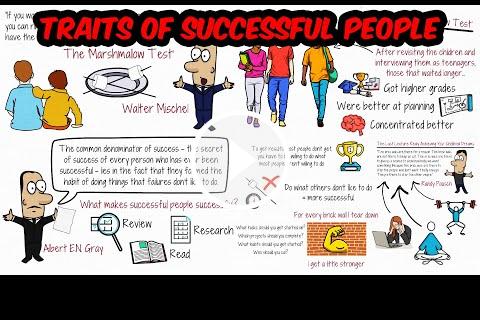
I would like to illustrate this point further by using research from a Stanford professor named Walter Mischel.
In the 1960s, this Standford professor began conducting a series of important psychological studies.
During his experiments, Mischel and his team tested hundreds of children — most of them around the ages of four and five years old — and revealed what is now believed to be one of the most
important characteristics for success in health, work, and life.
Let’s talk about what happened and, more importantly, how you can use it.
The Marshmallow Experiment
The experiment began by bringing each child into a private room, sitting them down in a chair,
and placing a marshmallow on the table in front of them.
At this point, the researcher offered a deal to the child.
The researcher told the child that he was going to leave the room and that if the child did not eat the marshmallow while he was away, then they would be rewarded with a second marshmallow.
However, if the child decided to eat the first one before the researcher came back, then they would not get a second marshmallow.
So the choice was simple: one treat right now or two treats later.
The researcher left the room for 15 minutes.
As you can imagine, the footage of the children waiting alone in the room was rather entertaining.
Some kids jumped up and ate the first marshmallow as soon as the researcher closed the door. Others wiggled and bounced and scooted in their chairs as they tried to
restrain themselves, but eventually gave in to temptation a few minutes later.
And finally, a few of the children did manage to wait the entire time.
Published in 1972, this popular study became known as The Marshmallow Experiment, but it wasn't the treat that made it famous.
The interesting part came years later.
As the years rolled on and the children grew up, the researchers conducted follow up studies and tracked each child's progress in a number of areas.
What they found was surprising.
The children who were willing to delay gratification and waited to receive the second marshmallow ended up having higher SAT scores, lower levels of substance abuse, lower likelihood of obesity, better responses to stress, better social skills as reported by their parents, and generally better scores in a range of other life measures.
The researchers followed each child for more than 40 years and over and over again, the group who waited patiently for the second marshmallow succeed in whatever capacity they were measuring.
In other words, this series of experiments proved that the ability to delay gratification was critical for success in life.
And if you look around, you’ll see this playing out everywhere…
If you delay the gratification of watching television and read a book, then you’ll learn more that will lead to having a successful business.
- If you delay the gratification by listening to an audio book when you are in your car instead of music then you will be able to gain the knowledge to improve your standard of living.
- If you delay gratification by purchasing expensive items of clothing then you may be able to save up enough money to invest in starting a business.
… and countless other examples.
Success usually comes down to choosing the pain of discipline over the ease of distraction. And that’s exactly what delayed gratification is all about, using your time and
resources wisely.
What else can you learn from this study?
The marshmallow test makes one thing clear: if you want to succeed at something, at some point you will need to find the ability to be disciplined and take action instead of becoming distracted and
doing what's easy.
Success in nearly every field requires you to ignore doing something easier (delaying gratification) in favour of doing something harder (reading a good
book).
But the key takeaway here is that even if you don't feel like you're good at delaying gratification now, you can train yourself to become better simply by making a few small
improvements.
We can train our ability to delay gratification, just like we can train our muscles in the gym.
So if you are keen to start a recruitment agency but don’t have the money to get started, then mastering the art of delayed gratification when spending money could pave the
way to saving the money needed to get started.
Here are my top five saving tips to get your finances in order to invest in your future.
1. Offset your mortgage
An offset mortgage is where you have savings and a mortgage with the same lender and your cash savings are used to reduce – or 'offset' – the amount of mortgage interest you're charged.
Instead of a standard savings account, you could place your savings in an offset account linked to your mortgage. This means you won't pay interest on the mortgage debt of the equivalent amount of the savings.
2. Don't pay an annual fee
Welcome to 2022, and for some, welcome to another fee. If you're paying an annual fee on your credit card, ask to have it waived off. Worst case scenario is your balance transfers to a better rate
and a card with no annual fee.
3. Stop spending on small luxuries
Your daily work lunches might seem cheap at £5 a day, but then that's £100 a month and approximately £1,200 a year.
Dedicate an afternoon each week to grocery shopping, and pack your lunches rather than purchasing them. Make sure you take a prewritten list to avoid impulse buying.
4. Transfer your debt
Dramatically lower your interest repayments by moving your existing debt onto a balance transfer card. Balance transfer cards can see you pay 0% interest for a fixed number of months.
With such significant saving potential, there's no excuses to not compare your options, transfer your debt and start saving! But make sure you pay it off before the
time runs out, or you could find yourself paying extra.
By following these five simple suggestions you will be well on your way to raising the finance to start your own recruitment agency.
Warmest
Joe Davis
P.S. If you would like to attend one of our recruitment start up Workshops to find out how you can have your share of recruitment’s £31 billion industry then all you will simply need to do is to contact us today on 0800 622 6877 to book your place.
Thought For The Day
“Time is free, but it's priceless.
You can't own it, but you can use it. You can't keep it, but you can spend it.
Once you've lost it you can never get it back”.